
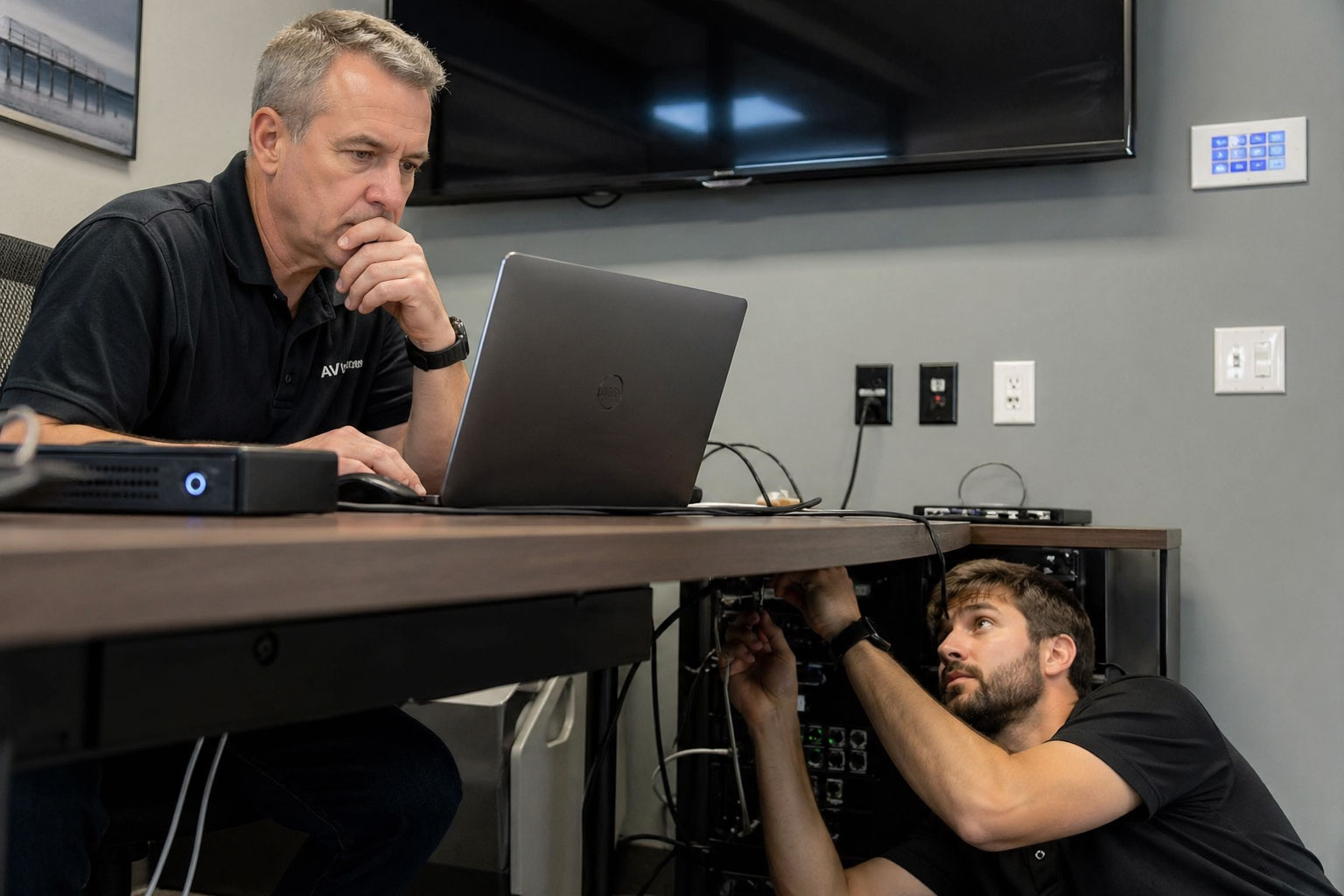
If you’ve been looking into upgrading your meeting rooms, planning a new office fit-out, or even just replacing a screen that’s been causing problems for months — you’ve probably come across the phrase “AV integration.” But what does it actually mean? And why should you care?
This guide cuts through the jargon and explains what AV integration involves, why it matters, and what to look for when you’re choosing a specialist to work with.
First, what does “AV” actually mean?
AV stands for audio-visual — the combination of sound and image technology used in commercial and residential environments. In practice, this covers everything from the screen in your meeting room and the speakers in your event space to the home cinema system in your living room and the digital signage in your reception area.
AV encompasses the hardware (screens, projectors, speakers, microphones, cameras, amplifiers), the cabling and infrastructure that connects it all together, and the control systems that allow you to operate it — ideally without needing a degree in engineering.
So what is AV integration?
AV integration is the process of designing, installing, and configuring multiple AV components so they work together as a single, seamless system. Rather than buying a screen here, a speaker system there, and a video conferencing unit somewhere else — and hoping they’ll all cooperate — an AV integration specialist designs the whole system from the ground up.
A well-integrated AV system means:
- One control interface for everything in the room
- Components that are specified to work together, not just in isolation
- Cabling and infrastructure installed cleanly, often invisibly
- Systems configured for the specific acoustics and dimensions of your space
- Technology that your team can actually operate without specialist knowledge
“The difference between a collection of AV equipment and a properly integrated AV system is the difference between technology that frustrates and technology that just works.”
Why does it matter for businesses?
For businesses, poor AV is surprisingly costly — even if the impact rarely shows up on a spreadsheet. When a video conferencing system drops out mid-presentation, when the screen in the boardroom won’t connect to a laptop, or when staff simply give up using the meeting room technology because it’s more trouble than it’s worth, the cost comes in lost time, damaged credibility, and reduced productivity.
According to research by Shure, poor meeting room technology costs UK businesses an average of 15 minutes per meeting — and for organisations with multiple meeting rooms running back-to-back sessions, that adds up fast.
Professional AV integration addresses these problems by ensuring your systems are designed for reliability, installed correctly, and configured to integrate with your existing IT infrastructure — including platforms like Microsoft Teams, Zoom, and Google Meet.
What does an AV integration project actually involve?
Every AV integration project is different, but the process typically follows a similar pattern:
- Site survey — a specialist visits your space to understand the room dimensions, acoustics, lighting, and how the space is used
- System design — equipment is specified to meet your requirements and budget, with cabling and infrastructure planned from the start
- Installation — hardware is fitted, cabling is routed cleanly (often concealed), and all components are connected
- Configuration — the system is programmed and calibrated for your specific environment
- Handover — your team is shown how to use the system, and documentation is provided
- Ongoing support — a good AV integrator stays in touch, offering maintenance and troubleshooting after installation
What should you look for in an AV integrator?
The AV market is crowded, and the quality of installation varies significantly. When evaluating an AV partner, look for:
- Technical expertise — do they understand the equipment they’re specifying, or are they selling you whatever carries the best margin?
- Site accreditations — if the project involves commercial or construction environments, CSCS and SSIP certifications matter
- Clear, jargon-free communication — you should understand what you’re buying and why
- References and case studies — look for evidence of similar projects completed to a high standard
- Aftercare and support — what happens when something goes wrong after installation?
Be wary of AV companies who lead with the brand names of the equipment rather than the outcome for your space. The best integrators design around your needs first, then specify the technology to deliver it.
AV integration across the Northwest
At AVIS AV, we work with businesses, contractors, and homeowners across the Northwest — delivering AV installations that are designed to work properly and supported long after we’ve left the building.
We keep things straightforward. We’ll visit your space, understand what you need, and give you an honest assessment of what’s possible within your budget. No unnecessary complexity. No upselling. Just a well-installed system that does exactly what it’s supposed to.
Ready to talk about your AV project? Get in touch with the AVIS AV team — we’re happy to answer questions and offer a free initial consultation.
AVIS AV — AV Made Simple. Installed Right. Supported Long After.